
October 24, 2026 · Andrew Buck
How to Find a Jiu Jitsu Gym (and Choose the Right One)
This guide shows you how to find BJJ gyms near you, tell which ones are real and active, and choose the one that's right for you.

Key takeaways
- Search Google Maps for several terms, like "BJJ," "jiu jitsu" and "no-gi," and include any gym within 20 to 30 minutes of home or work.
- A real BJJ gym has jiu jitsu on its timetable several times a week, and a head coach whose rank and lineage you can look up.
- Recent reviews and social posts show a gym is still active, and the same complaint repeated across reviews is a warning sign.
- The right gym is one where you feel safe, comfortable and a little challenged, so try two or three before you sign anything.
Most people find their first jiu jitsu gym the same way. They search "BJJ near me" and get a map full of pins.
That map is messier than it looks. Some of those places closed last year, and some are karate dojos or kickboxing gyms that show up for jiu jitsu without ever teaching it.
Even once you have a shortlist of real gyms, choosing between them is a personal call. This guide covers how to search, how to tell which gyms are legit, what makes a gym a good fit, and how to get the most out of a trial class.
Where should you search for a BJJ gym?
Google Maps is the best place to start looking for a BJJ gym. It puts every gym in the area on one screen, with its reviews, hours and website.
Search a few different terms, because gyms describe themselves in different ways:
- "BJJ"
- "Brazilian jiu jitsu"
- "jiu jitsu"
- "grappling" or "no-gi"
Don't stop at the city limits, either. The gym two suburbs over might be a shorter drive than the one "in town."
Travel time matters more than distance, because the best gym in the world is no use if you never make it to class. Anything within 20 to 30 minutes of home or work is fair game.
How can you tell if a BJJ gym is legit?
You can check whether a gym is real, active and properly teaching jiu jitsu from your phone in an evening. These checks will cut a long list of pins down to a few gyms worth visiting.
Is BJJ actually on the timetable?
A gym's class timetable, on its website or Instagram, tells you whether it really teaches jiu jitsu. Plenty of places come up in a jiu jitsu search because they mention it somewhere, while the timetable is all kickboxing, karate or fitness classes.
MMA gyms and general martial arts schools need the closest look. In our research, about 44% of gyms with MMA in their name didn't teach BJJ.
A name can mislead the other way, too. Studio 4 Athletics in Victoria, Canada sounds like a fitness studio, but it has no-gi BJJ on its timetable twice a week.
How often BJJ runs matters as well. A gym with jiu jitsu every day is a jiu jitsu gym, while one BJJ class a week, squeezed in between Muay Thai and boxing, is something else.
That's not automatically bad, but you'll learn a lot faster somewhere you can train three or four times a week. Some MMA gyms have great BJJ programs, and some have a jiu jitsu class in name only.
Who teaches the classes?
The head instructor is the most important thing to check. A good gym will tell you who teaches, what belt they hold and who promoted them.
In BJJ that's called lineage, and good coaches are proud of theirs. You're looking for a black belt running the place, or a brown or purple belt running an affiliate under one, with a clear line back to a coach you can look up.
If you can't find out who teaches or what rank they are, ask. A vague answer is a red flag, because self-promoted and made-up black belts do exist.
Is the gym still active?
A gym's Instagram or Facebook shows whether it's still going. A full mat, belt promotions, competition results and open mats are all good signs.
If the last post was two years ago, or every photo looks like a stock image, be wary. Then sort the Google reviews by newest, because a gym that people reviewed last month is still open.
What do the reviews say?
Google reviews tell you more than the star rating does, so read what people actually write. Do they mention the coaches by name, how beginners are treated, or the people they train with?
Read the bad reviews too, and how the owner replied. One bad review isn't a dealbreaker, but the same complaint over and over is, especially if it's about people getting hurt or about how hard it is to cancel.
Ask around, then message the gym
People who already train are the best source on local gyms. BJJ scenes are smaller than you'd think, and people who train tend to know which gyms are good, which ones are rough, and which coach just left to open their own place.
If you don't know anyone who trains, a local subreddit or Facebook group is the next best thing.
Then message your top picks and ask whether they do a free trial and which class suits a beginner. A gym that replies quickly with a straight answer is open and paying attention, and silence for a week tells you something too.
Does "jiu jitsu" mean BJJ where you live?
Jiu jitsu isn't always Brazilian jiu jitsu. Traditional Japanese jujitsu is a different martial art, and it's still common in continental Europe and parts of Asia.
If you're outside the US, UK or Australia, check that a gym's "jiu jitsu" is the Brazilian kind. Spellings like "jujitsu" or "ju-jutsu" are often a clue.
By the end of these checks you should have two or three gyms that are worth a visit.
What makes a good jiu jitsu gym?
No single formula makes a jiu jitsu gym good for everyone. A gym that one person loves, another quits after a week, because the right gym depends on what you want out of training.
A well-known team name is a good sign. A gym that's part of an established team, like Gracie Barra, Alliance, Checkmat, Atos or 10th Planet, usually has a head coach from a recognized lineage and standards to live up to.
Hundreds of reviews are another good sign. A gym with that many Google reviews has been around a while, with a community big enough that people bother to write about it.
Neither is a guarantee. A big-name affiliate can still be a bad fit, and a small independent gym with 30 reviews might be the best room in town. Reviews tell you a gym is popular, not whether it's right for you.
Beyond the name and the reviews, think about what you actually need:
- A schedule that works. Classes at times you can realistically make, week in and week out. In jiu jitsu, consistency beats everything.
- Gi or no-gi. Some gyms do mostly one or the other. If you have a preference, check the split.
- Beginner classes. A dedicated fundamentals class is ideal for your first few months, and it makes them a lot easier.
- The coach. You'll hopefully be learning from this person for years. Do you like how they teach, and do their explanations click for you?
- Price and contract. Know what you're signing up for, and be wary of anyone pushing a long contract before you've trained a single class.
Find the right mix of comfort and challenge
The best gym for you is one where you feel comfortable but still a little challenged.
Comfort keeps you coming back. People say hello when you walk in, the coach learns your name, and you look forward to going. If you dread walking through the door, you won't keep showing up, and showing up is most of the game.
Challenge is where growth comes from. Training partners who are better than you, and a coach who makes you work on the stuff you're bad at, keep you improving. If every roll feels easy, you'll stop getting better.
Too much comfort and you plateau. Too much challenge and you burn out or get hurt. The right mix is different for everyone, which is why you have to go and feel it out in person.
How do you know a gym is safe for beginners?
Feeling safe at your gym is the one thing that isn't down to personal taste, especially when you're new to jiu jitsu. A good gym looks after its beginners, and you can usually tell within a class or two.
Some signs you're in the right place:
- The coach keeps an eye on the rolls and steps in when things get out of hand.
- Upper belts go easy on new people and help them learn, instead of smashing them.
- A tap is respected instantly, every time.
- The mats are clean, and people show up with clean gear and short nails.
- All kinds of people train there: different sizes, different ages, men and women. That usually means the room is well looked after.
And some red flags:
- Injuries treated as a badge of honor.
- People going 100% on someone in their first week.
- A coach who sees someone get hurt and doesn't say anything.
- Pressure to spar before you feel ready, or before you've learned the basics.
If something feels off, trust that feeling. You don't owe a gym anything, and there are other gyms.
How should you use a free trial class?
Most gyms offer a free trial class, and some give you a whole free week. Take them up on it, and if you can, try two or three gyms before you decide.
You'll learn more from one class than from an hour of reading reviews. A few tips for your first visit:
- Show up early. Ten or fifteen minutes gives you time to fill out the waiver, meet the coach and get changed without rushing.
- Wear the right gear. For a gi class, a lot of gyms will lend you one. For no-gi, a fitted t-shirt or rashguard and shorts without pockets or zips are fine. Bring water, and flip-flops for walking off the mat.
- Watch the room. How do the upper belts treat the new people? Does the coach explain things clearly? Does anyone come over and say hi?
Then go home and ask yourself one question: do I want to go back? If the answer is yes, you've probably found your gym.
If you're only in town for a few days, a paid drop-in class does the same job, and the usual etiquette for training BJJ while traveling applies.
Find BJJ gyms near you on Jiu Jitsu Spot
Jiu Jitsu Spot does the searching and sifting for you. Every gym on the site is open, has Google reviews and has been checked for BJJ at that location, so you start with real jiu jitsu gyms instead of a map full of maybes.
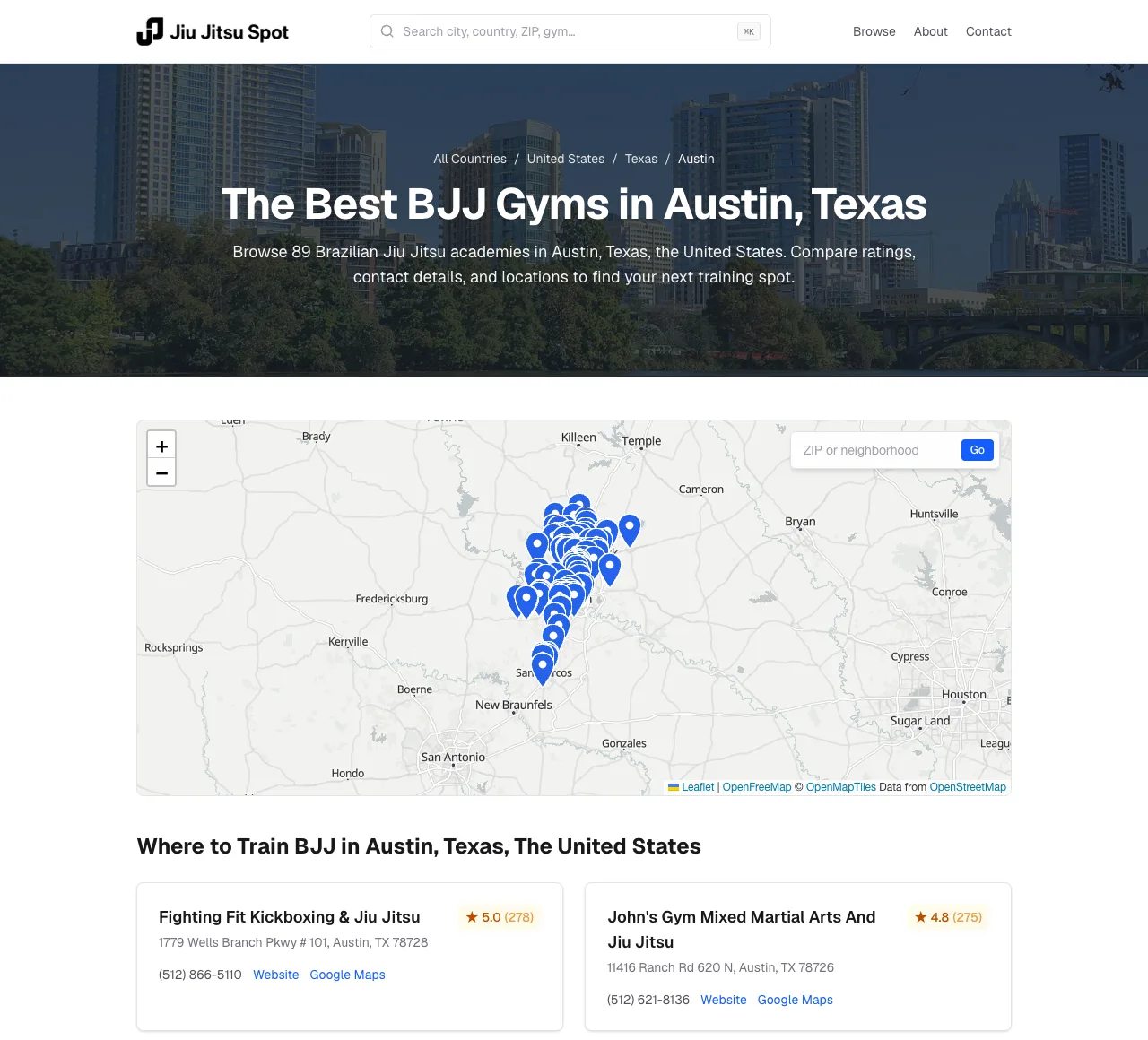
Our city pages cover the whole metro area, so the Austin page includes gyms out in Cedar Park and Buda. Type your city into the search bar and you'll see every gym near you on one map, with the most-reviewed near the top.
The directory covers more than 10,000 gyms in over 70 countries, so wherever you live, there's a good chance your shortlist is already waiting.
Final thoughts
Finding a place to train comes down to two jobs. First, find the gyms that are real, open and actually teaching jiu jitsu. Then pick the one where you feel safe, comfortable and a little bit challenged.
We've done the first job for you, and the second is the fun part. Search for your city or browse gyms by country, make your shortlist, and go try a class.
FAQ
Do I need to be fit before I start BJJ?
You don't need to be fit before you start BJJ, because the classes themselves build your fitness. Beginner classes go at a beginner's pace, and your cardio and strength improve as you keep training.
What's the difference between BJJ and Japanese jujitsu?
Brazilian jiu jitsu and traditional Japanese jujitsu are different martial arts with a shared ancestor. BJJ focuses on grappling on the ground and live sparring, called rolling. Japanese jujitsu is a traditional system that also includes throws, strikes and set techniques practiced with a partner.
How often should a beginner train BJJ?
Two or three classes a week is a good pace for a beginner: often enough to remember what you learned, with time to recover in between. Consistency matters more than volume, so pick a number you can keep up for months.
Should I start with gi or no-gi?
Either gi or no-gi is a fine way to start BJJ, and the basics carry over between them. Compared with no-gi, gi training is slower and more about grips. If you can't decide, a gym that teaches both is a strong fit, because you can try each.
Do I need my own gi for my first class?
You don't need your own gi for a first BJJ class, because many gyms lend one to people on a trial. Ask when you book, and wait until you've joined a gym before you buy one, since some gyms ask members to wear their own patches or a particular color.